
- FEATURES AND PERFORMANCE TARGETS
- QUANTITATIVE PERFORMANCE TARGETS
- MAIN R&D CHALLENGES
- IDENTIFIED SOLUTIONS
- EXPLOITATION OF RESULTS AND PATENTS
- MARKET AND INDUSTRIAL IMPACT
- APPLICATION SCENARIOS
Consortium Name: M2H – Machine to Human
Lead Partner: COMMED I A S.r.l.
Consortium Members:
- MoniTech S.r.l. – Monitoring Technologies – Spin-off of the University of Salento
- OFFICINE PRISCO SRL
- UNIVERSITY OF SALENTO – Department of Engineering for Innovation
Type of Activities: Industrial Research and/or Experimental Development
Final Project Objective
The project aims to substantially rethink manufacturing production processes and introduce innovation by improving their ability to adapt and reconfigure, integrating advanced ICT technologies with traditional production machinery. The reference application scenario is the leather goods manufacturing industry.
a. Features and Performance Targets
Within the leather manufacturing process, one of the most critical stages is the tanning process and quality control across the entire production chain, activities that are still typically carried out manually. Quality inspection is particularly critical for the footwear industry and can generate up to 30–35% waste in raw leather, while also creating the risk of producing non-compliant products due to undetected defects. This creates a clear need for a standardised and automated process for defect mapping, classification and traceability of individual hides throughout the production cycle, which is the core focus of the project.
The overall objective is to develop a new technology capable of making leather inspection objective and automated, enabling automatic classification after the pressing stage as well as the traceability of each individual hide throughout the manufacturing process. The technology is highly innovative and, as demonstrated by the absence of equivalent solutions in the current state of the art, is designed to fully leverage the principles of Industry 4.0. Innovation is introduced both through factory automation and through the interconnection of production technologies with enterprise ERP systems, together with the integration of production-planning support services that use information gathered by automatic inspection and classification systems.
b. Quantitative Performance Targets
With particular reference to system performance, the proposed solution is designed to eliminate the costs associated with the inspection of hides in the wet-blue stage while making the selection and classification process objective and standardised. The system also enables complete control of each individual hide through a tracking solution that automatically identifies it at every stage of the production process.
The proposed solution also lays the foundations for a future extension aimed at fully eliminating manual inspection and identification of defects on finished products, through a system capable of directly connecting the tannery with leather cutting departments.
c. Main R&D Challenges
The main research and development challenges addressed by the project include:
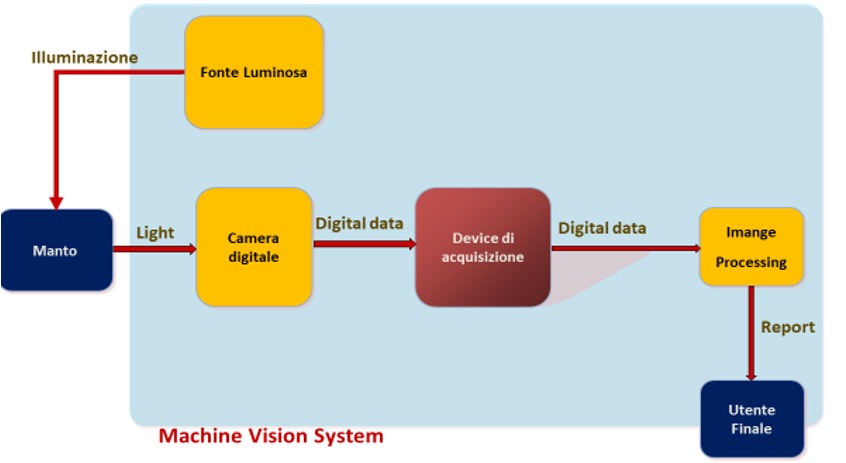
- designing a new apparatus — an interconnected production system integrated with the company information system — capable of automatically and contactlessly assessing the surface quality of hides in the wet-blue stage and classifying them into homogeneous quality categories;
- developing and implementing the prototype system and the related hardware and software components;
- designing an innovative service integrated with the company management model to support production-planning operators and optimise the logistics and availability of homogeneous leather batches according to order requirements;
- developing, designing and implementing an innovative prototype system for tracking hides in the wet-blue stage, capable of preserving the identification code of each individual hide throughout all subsequent tanning stages, from wet-blue to finished product;
- integrating the tracking system with the contactless classification system in order to connect the physical asset — the individual hide — with its digital information, including quality maps and classification data.
d. Identified Solutions
The proposed research was structured around a series of implementation objectives covering both technological and management aspects.
The project aims to innovate in the field of hide traceability technologies throughout the tanning process, as well as in methodologies for identifying defects during production by introducing multiple quality-control points. It also addresses the design and development of a management solution capable of supporting production planning within the tannery at both batch level and individual hide level.
e. Exploitation of Results and Patents
The project results can be directly transferred across the entire leather tanning industry.
Enabling companies in the sector to market not only physical products but also the information associated with them introduces a new source of value into an industry traditionally focused on mechanical, chemical and physical transformation processes. This creates the foundations for applying the key principles of Industry 4.0, turning production data into an integral part of the value proposition.
f. Market and Industrial Impact
The developed solution makes it possible to:
- establish a standardised method for classifying hides at the wet-blue stage and finished products, which can be shared with end customers and incorporated into contractual agreements;
- objectively assess the quality and classification of each individual hide, helping eliminate disputes with end customers regarding finished products;
- objectively assess the quality and classification of each hide in order to manage disputes concerning raw materials with suppliers;
- increase the economic value of each individual hide by combining the finished physical product with its associated information, such as the wet-blue quality map and perimeter data, helping reduce the need for repeated large-scale inspection by customers within their leather cutting facilities.
g. Application Scenarios
One of the pillars of social responsibility within the Italian tanning industry is the value placed on the people who work in the sector. They represent a strategic resource for an industry with a long tradition, where technological innovation and craftsmanship come together. Within a high-quality working environment, people must be able to apply their expertise and talent in the best possible way, transforming what would otherwise be waste into a material of excellence.
The system was designed and developed to enable:
- increased productivity;
- optimisation of cutting operations;
- end-to-end monitoring of the production process.
The project is funded under the POR Puglia ERDF-ESF 2014–2020 – European Regional Development Fund – Action 1.6 / FSC 2014–2020 “Research, Technological Development and Innovation” – Public Call “InnoNetwork” – Executive Determination No. 331/2020, amending Executive Determination No. 146 of 18 October 2018 concerning the provisional funding awarded to the “M2H” project – Application Code CBYX592.

Below is a breakdown of the eligible expenditure allocated to COMMED I A S.r.l. and the related funding awarded:
Eligible Industrial Research (RI) expenditure: €370,650.00
Eligible Experimental Development (SS) expenditure: €214,472.40
Total eligible expenditure: €585,122.40
Eligible Industrial Research (RI) grant: €296,520.00
Eligible Experimental Development (SS) grant: €128,683.44
Total eligible grant: €425,203.44